

Noticias del mercado & perspectivas
Anticípate a los mercados con perspectivas de expertos, noticias y análisis técnico para guiar tus decisiones de trading.

April's US earnings season is landing in a market that wants more than a good story. JPMorgan has already set a high bar with a strong result, and attention is now shifting to the engine room of the S&P 500: AI infrastructure where three companies are at the centre of that story.
Why this earnings window matters for AI
Microsoft, Alphabet and NVIDIA are not just participants in the AI cycle, they are building the physical and software architecture that other companies depend on: the chips, the cloud regions, the models and the tools. If this spending is going to deliver returns, the first signs may start to show in their quarterly results over the next few weeks.
Each company represents a different test.
- Microsoft: Whether enterprise AI adoption is translating into revenue and margin expansion
- Alphabet: Whether owning the full stack, from chips to cloud to distribution, is a durable advantage or simply an expensive position to defend
- NVIDIA: Whether the hardware cycle is still holding, accelerating or starting to level out
In 2026, the question is no longer whether AI investment is happening, the capital commitments are substantial and already publicly stated. The question is whether that spending is generating returns quickly enough to justify the scale of those bets.


The recent surge in gold prices, following recent events in the Middle East and the declining US Dollar (DXY), raises the question: Is this the end of the bull run for Gold (XAU/USD)? Gold started rising earlier this month after rejecting the price level of 1815.00. Since then, it has steadily climbed back to its previous peak of 1984.00, a resistance point that was notably challenging to breach in July.
This recent surge in gold prices, due in part to recent events in the Middle East, is attracting more bullish activity in the gold market. Simultaneously, the declining value of the US Dollar (DXY) has contributed to the upward movement of gold prices. Where can we see gold go in the near future?
In the market, assets tend to move in one of three directions: up, down, or sideways, often referred to as consolidation. Given that gold has reached its previous peak, it may seek potential support, which appears to be around 1930-1931. Concurrently, the US Dollar is experiencing a decline in value.
If gold manages to surpass the resistance at 1984.00, the next hurdle could be at 2060.00. This level is evident on the daily timeframe, where the price has approached 2060 on multiple occasions, only to be rejected. What about the DXY and XAU/USD?
The relationship between DXY (Dollar Index) and gold (XAU/USD) is intricate. Sometimes, when the dollar index is declining, the price of gold tends to move sideways or increase. However, examining larger time frames like the 4-hourly or daily charts reveals an inverse pattern of rejection and price rise between these two markets.
It's important to note that gold's movements are not solely dependent on the USD; other significant factors, including news, social and geo-political events can also play a substantial role in influencing its price fluctuations. Why is gold so important? Apart from its physical shine and the enduring symbolic connection with wealth seen throughout human history, gold holds significance as a historically reliable store of value and a means of exchange.
Unlike many other commodities, gold does not diminish or get depleted, giving it a timeless sense of worth. It can act as a safeguard against the erosion of currency value caused by inflation, prompting numerous investors to view gold as an alternative asset and a method of preserving their wealth. How can I trade gold?
At GO Markets, we provide Metal CFDs for trading, offering not only gold but also silver and copper futures. Our goal is to deliver an exceptional trading experience to our clients. We take pride in offering one of the best online trading platforms for gold, silver, and copper futures, in addition to providing access to FX, Soft Commodities, Shares, and Indexes, enabling our clients to diversify their investments across various financial markets.
The Walt Disney Company (NYSE: DIS) reported its fourth quarter and full fiscal year 2023 results ending September 30, 2023, after the market close in the US on Wednesday. Company overview Founded: October 16, 1923 Headquarters: Team Disney Building, Walt Disney Studios, Burbank, California, United States Number of employees: 220,000 (2022) Industry: media, entertainment Key people: Mark Parker (chairman), Bob A. Iger (CEO) The results World’s third largest entertainment company reported revenue of $21.241 billion for the quarter (up by 5% year-over-year), narrowly missing analyst estimate of $21.369 billion.
Revenue for the full year reached $88.898 billion, an increase of 7% from the previous year. Earnings per share reported at $0.82 per share, above analyst estimate of $0.71 per share. EPS for the full year reached $3.76 per share.
Disney+ added 7 million core subscribers during the previous quarter. CEO commentary "Our results this quarter reflect the significant progress we’ve made over the past year," Robert A. Iger, CEO of Disney commented on the latest results. "While we still have work to do, these efforts have allowed us to move beyond this period of fixing and begin building our businesses again.
We have a solid foundation of creative excellence and innovation built over the past century, which has only been reinforced by the important restructuring and cost efficiency work we’ve done this year, and we’re on track to achieve roughly $7.5 billion in cost reductions. Combined with our portfolio of valuable businesses, brands and assets – and the way we manage them together – Disney has a strong hand that differentiates us from others in our industry." "As we look forward, there are four key building opportunities that will be central to our success: achieving significant and sustained profitability in our streaming business, building ESPN into the preeminent digital sports platform, improving the output and economics of our film studios, and turbocharging growth in our parks and experiences business. We have already made considerable advancements in these four areas and will continue to move forward with a sense of purpose and urgency, and I’m bullish about the opportunities we have before us to create lasting growth and increase shareholder value," Iger concluded.
The latest results had a positive impact on the stock in the after-hours trading. Shares were up by around 3%.The stock is down by 2.59% in the past year at $84.50 per share. 1 month: -0.41% 3 months: -3.42% Year-to-date: -2.74% 1 year: -2.59% Walt Disney price targets JP Morgan: $120 Seaport Global: $93 Bernstein: $103 Rosenblatt: $103 B of A Securities: $110 Truist Securities: $105 Raymond James: $97 Wells Fargo: $110 Goldman Sachs: $136 Deutsche Bank: $135 Walt Disney is the 68th largest company in the world with a market cap of $154.61 billion, according to CompaniesMarketCap. You can trade The Walt Disney Company (NYSE: DIS) and many other stocks from the NYSE, NASDAQ, HKEX, ASX, LSE and DE with GO Markets as a Share CFD.
GO Markets now offers pre-market and after-market trading on popular US Share CFDs. Trade the pre-market session: 4:00am to 9:30am, normal session, and after-market session: 4:00pm to 8:00pm, Eastern Standard Time. Why trade during extended hours?
Volatility never sleeps. Trade over earnings releases as they happen outside of main trading hours Reduce your risk and hedge your existing positions ahead of a new trading day Extended trading hours on popular US stocks means extended opportunities Sources: The Walt Disney Company, TradingView, MarketWatch, CompaniesMarketCap, Wikipedia, Benzinga
Tuesdays FX session is turning out to be a mirror image on Monday’s session Where the USD was battered against its major peers. Today, seeing almost a full retrace of those moves as USD is once again king. The Dollar Index (DXY) respected the upward trendline support that has led DXY higher since July (with the exception of a brief break in early September).
A less aggressive CNH fix by the PBoC and sour risk sentiment also helping the Dollar. DXY rebounding strongly in Tuesday’s session so far, the 105 level will be key. DXY has found increasing resistance above this level for the last 12 months and with an empty news calendar in the US a push higher through the key 105 level in today’s session would be tough going.
GBPUSD had an initial and very brief spike higher on a hot headline UK average earnings figure, but quickly retraced from a high of 1.2530, losing the psychological 1.2500 as other jobs data painted a grim picture, with the unemployment rate a 200k+ drop in the employment and downward revisions on previous data weighing on Sterling. USDJPY continued to march higher, looking to fill the gap after the Monday open gap down on Japanese jawboning over the weekend. USDJPY did breach the psychological 147 level earlier in the session but has found some resistance there and at the 23.6 Fibonacci level (147.06) going into the US session.
AUDUSD gave back some of the big gains in Mondays session, but a rebound in the price of iron ore and a relatively firm CNH helped the Aussie stem it’s losses against the USD and certainly out performed its Antipodean rival the NZD. AUDUSD holding the key 0.6400 level trading within 0.6417-40, AUDNZD trading near the top of its recent range, getting to a high of 1.0885 in the Asian session. NZD undermined by downgrades to NZ fiscal projections in a pre-election report.
The US economic calendar is empty of key risk events in Tuesday’s session, all eyes will be on tomorrows pivotal CPI report though.
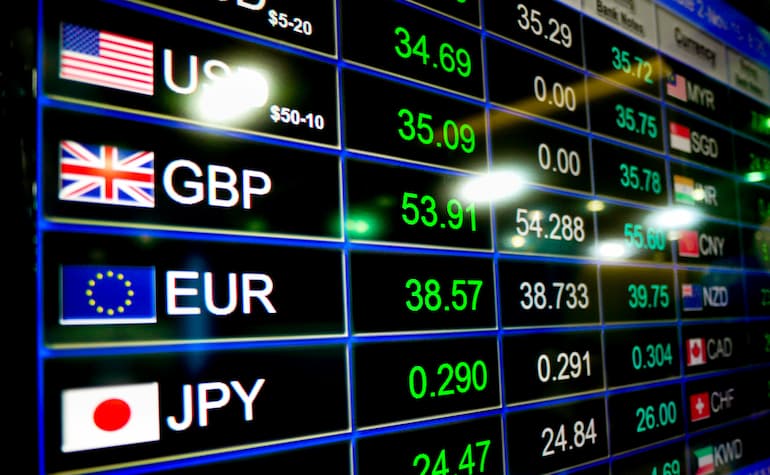
Comments from Bank of Japan governor Ueda over the week saw USDJPY gap significantly lower at the Asian session open. The pair now trading well under 147 from eight-month highs at Fridays close. Ueda commented that the BoJ cannot rule out that they might have sufficient data by year-end to determine whether they can end negative rates, this brings the timeline forward of Japanese normalization, previously not signaled to begin until 2024.
US-JPY rate differentials compressed on the news, with the predictable move in USDJPY to the downside. USDJPY found some support at the 4H trendline and has retraced some of its losses in the EU session, hovering just below the key resistance level of 146.63, a resistance level that capped gains in the pair during August. Key UK wage and jobs data released on Tuesday, is looking to show some cooling in the UK jobs market but probably not enough to avoid a September BoE rate hike.
GBPUSD holding the major support at 1.2450 and continuing to rise, reclaiming the psychological 1.2500 level, and piercing trendline resistance to the upside. Tomorrows figure, if a big miss or big beat, should see some action in GBP as rate hike/hold odds adjust. The Aussie dollar has surged today, AUDUSD breaking out of its tight September range and reclaiming the major S/R level at 0.6400.
AUD gaining alongside the CNH after the PBoC set the strongest fix signal on record. Chinese data released over the weekend also showing the worlds second largest economy bouncing back from deflation.
Uber Technologies Inc. (NYSE: UBER) released its latest earnings results before the market open in the US on Tuesday. Let’s see how it performed in Q3. Company overview Founded: March 2009 Headquarters: San Francisco, California, United States Number of employees: 32,800 (2022) Industry: Transportation, food delivery Key people: Ronald Sugar (Chairman), Dara Khosrowshahi (CEO) The results The company reported revenue of $9.292 billion for the quarter (up by 11% year-over-year), missing analyst estimate of $9.539 billion.
Earnings per share (EPS) reported above estimates at $0.10 per share vs. $0.071 per share expected. Uber completed 2.4 billion trips during the quarter, up by 25% during the same period last year. Monthly active platform consumers reached 142 million in Q3, up by 15% year-over-year.
CEO and CFO commentary "Our relentless focus on improving the product experience for both consumers and drivers continued to power profitable growth, with trip growth accelerating to 25%," Uber CEO, Dara Khosrowshahi said in a statement. "Uber’s core business is stronger than ever as we enter the busiest period of the year," Khosrowshahi added. "Strong topline trends and record profitability demonstrate the durability of our growth and the significant earnings power underlying our platform," Nelson Chai, CFO of the company said about the latest results. "We continue to make disciplined investments in growth opportunities to support long-term value creation for all stakeholders," Chai concluded. The stock was up by around 1% on Tuesday, trading at the highest level since 11th September at $48.94 a share. Stock performance 1 month: +5.49% 3 months: +8.92% Year-to-date: +98.91% 1 year: +79.26% Uber price targets Keybanc: $50 Seaport Global: $51 Needham: $60 RBC Capital: $58 Wells Fargo: $59 Loop Capital: $58 JP Morgan: $56 Truist Securities: $60 Morgan Stanley: $60 Uber is the 131st largest company in the world with a market cap of $100.92 billion, according to CompaniesMarketCap.
You can trade Uber Technologies Inc. (NYSE: UBER) and many other stocks from the NYSE, NASDAQ, HKEX, ASX, LSE and DE with GO Markets as a Share CFD. GO Markets now offers pre-market and after-market trading on popular US Share CFDs. Trade the pre-market session: 4:00am to 9:30am, normal session, and after-market session: 4:00pm to 8:00pm, Eastern Standard Time.
Why trade during extended hours? Volatility never sleeps. Trade over earnings releases as they happen outside of main trading hours Reduce your risk and hedge your existing positions ahead of a new trading day Extended trading hours on popular US stocks means extended opportunities Sources: Uber Technologies Inc., TradingView, MarketWatch, MetaTrader 5, Benzinga, CompaniesMarketCap, Wikipedia
Meta Platforms Inc. (NYSE:META) announced its latest financial results after ther market close in the US on Thursday. Marc Zuckerburg’s company crushed analyst estimates for the quarter. Let’s take a closer look at how the company and the stock has performed.
The results Meta reported revenue of $34.146 billion for Q3 (up by 23% year-over-year) vs. $33.579 billion expected. EPS reported at $4.39 per share (up by 168% year-over-year) vs. $3.643 per share estimate. The company expects revenue of around $36.5 to $40 billion in Q4.
CEO commentary "We had a good quarter for our community and business," Mark Zuckerberg, CEO of Meta Platforms said in a statement to investors. "I'm proud of the work our teams have done to advance AI and mixed reality with the launch of Quest 3, Ray-Ban Meta smart glasses, and our AI studio," Zuckerberg added. The stock The stock was down by 3.73% at $288.35 a shon Thursday before the latest earnings were announced. However, the stock has experienced a tremendous year so far and is up by over 130% year-to-date.
Stock performance 1 month: -3.95% 3 months: -11.41% Year-to-date: +139.61% 1 year: +190.68% Mate Platforms stock price targets Truist Securities: $405 RCB Capital: $400 Piper Sandler: $355 Wedbush: $350 Wells Fargo: $380 Barclays: $400 Rosenblatt: $411 Keybanc: $380 JP Morgan: $400 Meta Platforms is the 7th largest company in the world with a market cap of $741.01 billion. You can trade Meta Platforms Inc. (NASDAQ:META) and many other stocks from the NYSE, NASDAQ, HKEX, ASX, LSE and DE with GO Markets as a Share CFD. GO Markets now offers pre-market and after-market trading on popular US Share CFDs, including Meta Platforms.
Trade the pre-market session: 4:00am to 9:30am, normal session, and after-market session: 4:00pm to 8:00pm, Eastern Standard Time. Why trade during extended hours? Volatility never sleeps.
Trade over earnings releases as they happen outside of main trading hours Reduce your risk and hedge your existing positions ahead of a new trading day Extended trading hours on popular US stocks means extended opportunities Sources: Meta Platforms Inc., TradingView, MarketWatch, Benzinga, CompaniesMarketCap