

Tin tức & phân tích thị trường
Luôn dẫn đầu thị trường với phân tích chuyên sâu, tin tức và phân tích kỹ thuật từ chuyên gia để hỗ trợ các quyết định giao dịch của bạn.
Mùa thu nhập của Mỹ tháng 4 đang rơi vào một thị trường mong muốn nhiều hơn là một câu chuyện hay. JPMorgan đã đặt ra một tiêu chuẩn cao với kết quả mạnh mẽ, và sự chú ý hiện đang chuyển sang phòng động cơ của S&P 500: cơ sở hạ tầng AI, nơi ba công ty là trung tâm của câu chuyện đó.
Tại sao cửa sổ thu nhập này lại quan trọng đối với AI
Microsoft, Alphabet và NVIDIA không chỉ là những người tham gia vào chu trình AI, họ đang xây dựng kiến trúc vật lý và phần mềm mà các công ty khác phụ thuộc vào: chip, khu vực đám mây, mô hình và công cụ. Nếu chi tiêu này mang lại lợi nhuận, các dấu hiệu đầu tiên có thể bắt đầu hiển thị trong kết quả hàng quý của họ trong vài tuần tới.
Mỗi công ty đại diện cho một bài kiểm tra khác nhau.
- Microsoft: Việc áp dụng AI cho doanh nghiệp có chuyển thành mở rộng doanh thu và lợi nhuận hay không
- Bảng chữ cái: Cho dù sở hữu toàn bộ ngăn xếp, từ chip đến đám mây đến phân phối, là một lợi thế lâu dài hay đơn giản là một vị trí đắt tiền để bảo vệ
- NVIDIA: Cho dù chu kỳ phần cứng vẫn giữ, tăng tốc hoặc bắt đầu cân bằng
Vào năm 2026, câu hỏi không còn là liệu đầu tư AI có xảy ra hay không, các cam kết vốn là đáng kể và đã được công bố công khai. Câu hỏi đặt ra là liệu chi tiêu đó có tạo ra lợi nhuận đủ nhanh để biện minh cho quy mô của những cược đó hay không.
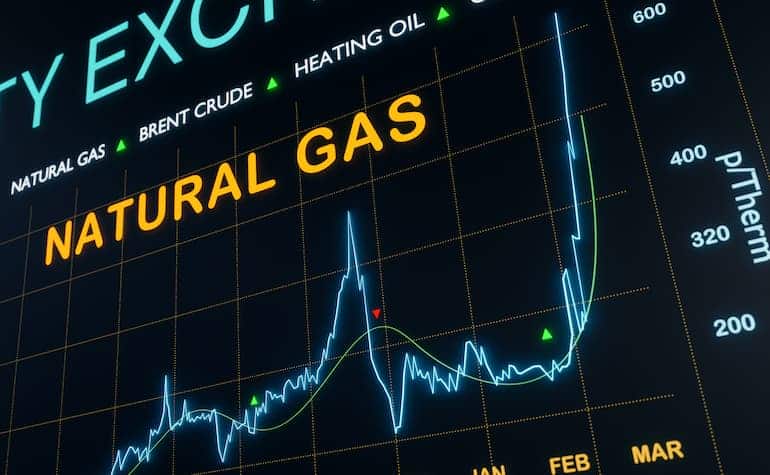

The United States used 30.28 trillion cubic feet of natural gas in 2021, making them the world’s largest consumer of natural gas. Natural gas consumption in the United States has two seasonal peaks, largely reflecting weather-related fluctuations in energy demand. One of the biggest consumptions of gas is industrial, residential and commercial cooling and heating systems (eia, 2022).
As the world’s largest user of natural gas transitions out of summer, will this change indicate a decrease of their natural gas consumption? Could the decrease in demand for cooling be reflected on the technical charts? On a daily timeframe, natural gas has been on a steady upward trend since the end of June, in tandem with the beginning of summer in the US (seen on the chart below).
A trendline from the beginning of that trend until now can be drawn, and we can see recently that line has been broken by a daily candlestick, closing below the trendline which can indicate a change in trend for natural gas. After the strong break below of the trendline followed by multiple bearish daily candlesticks, we can consequently expect further downside movement for natural gas, after breaking through a strong support at $8.4, in all probability with natural gas currently sitting at $7.895 we could see natural gas come down to the next support level around $7.57.

Have you ever heard the saying, “70% of trading is in the head”? This is because the markets are mostly moved with sentiment, a good barometer to gauge is the Fear and Greed index, emotions trigger actions, there is a reason why there are sellers and buyers in the market at the same time, yes it can be attributed to the way people take in information or understand the data, in a normal day, there are always winners, as there are always losers. So, with that in mind you might understand that this information or data is truly important to traders as it impacts heavily on the markets, as such that, as a trader it would be irresponsible for you to focus solely on the Technical Analysis and disregard the Fundamentals.
However, you could be able to trade Fundamentals without the Technical Analysis. What is Fundamental News? The best way to answer this, is by acknowledging that the performance of an economy is a direct result of different political, social and economic outcomes.
These could differ from the release of figures of the unemployment rate to interest rates, from elections to the GDP, to geopolitical events such as the invasion of Ukraine to a countries coup or BREXIT. All of these have profound effects on the price of commodities, currencies, bonds, or securities, as it would either make the asset easily accessible or as in recent times with COVID it makes is harder to supply it when there is huge demands. Investors are always on the lookout for small details that would help them decipher if their investments are in sound condition or if they need to do something to avoid losing their positions.
Typically, if you are trading CFDs you would look to an Economic Calendar – It’s just like a standard calendar, which provides timelines of specific reports and/or meetings which will take place in the future, from various countries around the world. You could see one here at Forex Factory. A great tool which will aid traders to set up their trades in advance or allow them to make a decision to see if it would be wise to keep a trade open during the event, or open a trade before or wait until the fact to enter the market.
As you begin to follow economic announcements, you may understand why some events—like the consumer price index—may cause markets to move. But you may wonder why it’s important to follow lesser events, like the food price index. Usually, a major event provides an indication of the state of the economy.
But traders follow lesser events because they provide an indication of upcoming major announcements. For example, a jump in food prices may mean the consumer price index will jump as well. An example of an economic calendar is below.
Fundamental Analysis consists of the trader keeping track of all these factors within the reports and how they have affected the market. Fundamental analysis can also cover broader aspects of trading depending on the asset in question. The various fundamental factors can be grouped into two categories: quantitative and qualitative.
The financial meaning of these terms isn't much different from their standard definitions. Here is how a dictionary defines the terms: Quantitative – "related to information that can be shown in numbers and amounts." Qualitative – "relating to the nature or standard of something, rather than to its quantity." In this context, quantitative fundamentals are hard numbers. They are the measurable characteristics of a business.
That's why the biggest source of quantitative data is financial statements. Revenue, profit, cash flow, assets, wages and more can be measured with great precision. Fundamental Trading can be done in various ways depending on your availability – some reports are released late in the night or early morning depending on your perspective, which mean, you may be asleep so trading these may require a level of organisation from your part in terms of understanding how to set up pending orders, with the right risk management in place to take you out of the trade whether it has reached your desired profit limit or the amount you’d be happy to risk losing or trade the action live as you see the reaction of the price movement.
All In all Fundamental news, analysis and trading are a major facet of trading, it is also right to mention, that some fundamental traders would incorporate technical analysis from time to time to create stronger affirmations in their research. Sources: babypips.com, https://www.contracts-for-difference.com/, https://www.investopedia.com/, www.forexfactory.com
In my previous article we discussed, what is an EA and their benefits. To read up on their disadvantages please follow the link to an article written by my colleague Daniel Vary here. Today we are going to discuss how you would use a VPS to enhance the use of an EA, especially if you are running various EAs simultaneously.
What is a VPS? A virtual private server (VPS) is a virtual program sold as a service by an Internet hosting service. The virtual dedicated server (VDS) also has a similar meaning.
A virtual private server runs its own copy of an operating system (OS), and customers may have superuser-level access to that operating system instance, so they can install almost any software that runs on that OS. For many purposes it is functionally equivalent to a dedicated physical server and, being software-defined, can be created and configured much more easily. Depending on the resources that you choose, the location of the server, the virtualization technology, and the quality of your service, the price of your VPS will change.
GO Markets provides a VPS to all its clients, it’s a free trading tool we make available which would otherwise come with a monthly fee. Why would traders use a VPS and what advantages do they offer? As a trader who is looking to incorporate an Expert Advisor in their trading strategy, they may well need the use of a VPS, this helps to facilitate a smooth working condition for one or several EAs running simultaneously and to run as effectively as possible.
An Expert Advisor is a tool that is programmed to work 24/7, it is imperative that the running of your trading system and the vessel which it operates in i.e. computer or laptop is not disrupted, go offline or lose power, otherwise you will find that your EA won’t be able to operate, open, close trades or do whatever you intend to do with it. A simple advantage to think about, is purely that a VPS enhances the EAs capabilities and with it, it may improve your trading goals. A VPS facilitates a smooth and quick link to a reliable server, that means it keeps the connection alive for as long as possible to allow the EA to do its job, getting access to a reliable server should be your highest priority, especially given the nature of how fast paced markets like Forex markets can be.
Choosing a VPS provider? There are few important points that you need to look into when choosing the type of VPS you want to acquire. There are some key features to look understand to get a VPS that will fit within your EAs specifications, your trading strategy and style.
We will look at the specific features of the VPS shortly but first you need to consider which Operating System OS you like your VPS to run on, Windows or Linux? Linux is an open-source operating system and is cheaper than windows. The Windows VPS hosting can be preferred if you are developing in.NET or if you have applications that are designed for the Windows platform.
RAM – It stands for random-access memory. It means that your computer RAM is essentially short-term memory where data is stored as the processor needs it. The Ideal RAM for a VPS for this purpose would be 4 GB.
If you are running several EAs, which use up more than the available RAM, then may need to look for a bigger VPS or simply add another VPS on another account. CPU – Central processing unit, is a principal part of any digital computer system, generally composed of the main memory, control unit, and arithmetic-logic unit. They have proved to work smoothly even at peak times depending on the quality and size of the processor.
You need to have 14nm architecture with a multi-core for multitasking but a 6vCPU works in most normal cases. Hard disk HDD – The traditional hard disk storage space will always be bigger and more inexpensive. But a solid-state drive is recommended for a VPS hosting.
They are fast at rebooting; the performance is certainly huge and transfer speeds are more than the traditional disks. The SSDs are resilient during power failures, which makes them a perfect fit for VPS hosting. A faster hard drive is necessary because even if the RAM and CPU are fast you need an equally faster storage drive to service those requests Go Markets VPS As a valuable client of GO Markets, you can get access to a VPS once you have a live account with us.
Simply, by applying for one via your Client Portal. The VPS runs on both MT4 and MT5 systems and allows you to execute trades using EAs, quicker and easier. GO Markets offers free monthly VPS access to clients completing a minimum trade volume of US$1m per calendar month (approx. 5 round turn FX lots).
If this volume is not met, a VPS service fee will be applied per month which will be charged from trading account. Please see below the specifications of our VPS below. Our VPS is a Shared Hosting, managed Cloud based solutions running on Windows 2016.
Sources: Wikipedia, Babypips, GO Markets, operavps.com, www.websitebuilderexpert.com,
Expert Advisors are programs which are configured to execute trades or read market price movements. When a parameter is met or triggered, it commands the EA to open or close trades on your behalf whilst you are otherwise engaged or sleeping. EAs are compatible to be used on the Metatrader 4 and 5 systems.
Algorithmic trading is a method of executing orders using automated pre-programmed trading instructions accounting for variables such as time, price, and volume. This type of trading attempts to leverage the speed and computational resources of computers relative to human traders. In the twenty-first century, algorithmic trading has been gaining traction with both retail and institutional traders.
It is widely used by investment banks, pension funds, mutual funds, hedge funds that may need to spread out the execution of a larger order or perform trades too fast for human traders to react to. It is now also widely available to retail clients. A study in 2019 showed that around 92% of trading in the Forex market was performed by trading algorithms rather than humans.
What are the advantages of using EA’s? Timesaving – The Forex market is open 24 hours. As a trader you are always looking for an opening in the market for you to execute an order, however, as a human you need to be able to sleep to operate normally, especially if you want to live a healthy life.
With an EA in place, you can time the market, set alerts, watch various markets simultaneously, set open and close trades yourself or allow it to open and close trades on your behalf. For a lot of forex traders who’d like to profit from market movements during a particular trading session but are stuck in a different time zone, using an expert advisor means that they don’t need to worry about trading sleep for pips. Emotionless Trading – The market is wholly affected by emotion, whether the emotion makes you want to buy or sell an asset is down to how you understand the information or how you perceive the charts.
With emotion you can either be gripped in a circle of greed or a loss of confidence which can cloud your thinking and deviate from a trusted strategy. An EA does not suffer from these as it just needs to meet various mathematical parameters to work. Expert advisors are wired to stick to system commands and take valid trade signals, without feeling pain from losses or joy from wins.
Backtesting - Another advantage of having an expert advisor is the ease of conducting backtests, particularly on an MT4 platform. In fact, Babypips have a short tutorial on how to backtest and EA on MT4 and you’d be surprised to know that it just takes a few clicks to see how a system fared over several years. This is mainly used, to make sure that the EA you have acquired, works in the way you want it to work before letting it loose on your live account with real money at stake.
Quick and Flexible – EAs can open and close trades in a blink of an eye; whilst humans tend to second guess these actions by taking price movements and reading indicators, an EA is built to take these decisions with mathematical precision. Depending on the EA you are also able to check multiple markets and have various EAs on one system at the same time. Some of these features are also extremely useful for short term traders who trade on smaller movements of 1 – minute to 5 – minutes charts.
Human Error and Accessibility – Human error have cost many a trader in years past, opening the wrong direction on trades, making the size of the position too big or too small, or opening a trade whilst misreading the technical can all have a negative effect on your trading experience. Having an EA can limit these errors as EAs are programmed to your specifications and they would never deviate from that, unless they are not set properly to begin with, but this is the reason why you would always backtest! EAs are available with a decent variety and with great accessibility to these programs, it is no hard to see why they are becoming the automated popular choice for traders.
In my follow up article on this subject, I will talk about the use of a VPS and popular EAs. If you like to incorporate your MT4/5 systems with EAs, you can talk to one of our Account Managers who will be happy to talk you through the process, feel free to contact us on +61 3 8566 7680 or email me directly on [email protected] Sources: Tradersunion.com, IG, Wikipedia, Babypips.
What is an ETF Most people have heard of ETFs but not everyone knows what they are. An ETF is an Exchange Traded Fund and they are extremely popular amongst retail investors and novice investors. Companies such as Beta shares, Vanguard, Blackrock and others create and manage these holdings on behalf of investors.
An ETF is a collections of stocks that is grouped together to generally replicate the structure and weighting of an index such as the ASX200 or the Nasdaq. Alternatively, an ETF can also be a collections of assets that represents a sector or industry such as an Energy ETF. The market for ETFs has grown substantially with new ETFs being created regularly.
The value for ETFs in the USA by the end of November 2021 was worth 3 Trillion dollars. The advantages of investing in ETFs is that they are generally well diversified and that they don’t require constant administration or management. In addition, they are seen as being relatively passive as holders of shares of the ETF do not need to manage the buying and selling of the holdings of the ETF.
Many ETFs offer dividend reinvestment plans included many investors will not look at their holdings for a long time. The truth of ‘Passive’ Investing Are ETFs really passive? The reality is ETFs require a great deal of management and administration.
The managers of the ETFs must constantly adjust their holdings accurately to reflect either the rules of the ETF or the weighting of the companies on the index. Therefore instead of the ETFs seemingly operating independently they are actually constantly changing all the time. Some ETFs will adjust by buying or selling shares at the end of the trading day.
As indices rebalance, usually every three month, six months or 12 months, the ETF must reflect those changes. The ‘Flow’ on effect The issue is when an Index rebalances, the ETF is required to buy or sell the stocks that are being removed or added. As ETFs have such large holdings in the individual companies their buying and selling can often have quite a strong effect on the price flow of the shares.
This problem is exacerbated with ETFs that hold small cap companies. These smaller companies are even more at risk of a run by an influx of money coming into an ETF’s buying/selling patterns. This can lead to undesirable outcomes as the managers of the ETF must fight themselves to reach their required buy/sell volume of assets.
Potential Issues Blackrock is one of the companies that creates and hold ETFs in various sectors. One of its ETFs tracks 30 energy stocks. At one stage it held 8% of the shares of one of its holdings of one stock.
The cashflows from investors into the ETF were artificially driving up the price of the stock. Essentially, with so many shares to buy and sell, the ETF is ‘fighting itself ‘to fill its orders. This sees a very sharp increase/decrease in price usually with large volume.
In response to this unique problem the S&P Dow Jones Index in consultation with Blackrock created new rules for holdings to be added to the ETF and improve liquidity. For traders, ETFs create potential trading opportunities because as the old saying says “follow the money”. The ‘liquidity vacuum’ that ETFs create can often be quite aggressive moves to a stock’s price action substantially.

Trading FOREX, equities, commodities, and any other asset can be an emotional rollercoaster. With so many different emotions and external factors difficulties impacting a trade, it is crucial that before any trade is executed a trading plan is produced to minimise the impact of the ‘noise’. Generating the Idea The first step to any plan is to generate a trading idea.
Trade ideas, come from one of three sources. A fundamental source, a technical source, or a mix of both. What does this mean exactly?
Well, when generating ideas from a fundamental perspective, a trader can generate idea based on economic events, monetary policy from a Central bank or company relevant information just to name a few. From a technical perspective, a trader may find that an asset is trading near a potential support or resistance level or developing into a breakout pattern. Alternatively, the price may have touched an important moving average which indicates it may be ready to trade.
Traders can also put these ideas together to come up with even more robust trading ideas. Background economic factors and sector analysis Before entering a trade, a good trader should have at the very least a rudimentary understanding of the relevant sector or economic factors that may influence the trade. For example, a trader decides to trade the AUDUSD currency pair.
The trader has seen that the price is approaching a short-term support point and decides to buy the pair expecting the price to bounce of the level. However, the trader is not aware that the Federal Reserve has just increased interest rates which has increased the value of the USD. Consequently, the price goes against the trader.
Technical breakdown Prior to entering any trade, the trader should analyse the price chart and set up relevant support and resistance levels. This allows the trader to have a clear idea of key supply and demand zones for the asset before the emotions of the actual trade become prevalent. To effectively go about this step, support and resistance levels can be analysed on multiple time frames to gain an even greater edge. [caption id="attachment_272243" align="alignnone" width="2560"] Business Team Investment Entrepreneur Trading discussing and analysis graph stock market trading,stock chart concept[/caption] Entry condition Having a trade idea is one aspect however having a clear entry criterion will help reduce the impact of emotion when watching the trade unfold.
Some examples of potential entries conditions can be related to a break and retest of a certain level for an entry or waiting for a specific candlestick pattern. Furthermore, an entry may also be defined by a disproportionate increase in volume supporting a breakout. Exit Conditions Like determining entry conditions having pre planned exit points can improve the management of emotions during also trade whilst also enhancing risk management.
Setting take profit targets/stop loss areas will help ensure that a trade is well structured even before initiating the trade. Having pre-determined exit points can also help determine if a trade is worth entering in the first place as it allows for a determination of the potential risk reward before execution. Risk management No matter whether the trade is a scalp, swing trade or longer-term investment, each should have clear risk management guidelines.
Good risk management involves the use of stop losses and correct sizing of a trade. One method that can be effective is to have a maximum amount of the total account that you are willing to lose per trade. This could be a percentage figure or a fixed amount.
For example, if the total account size is $10,000 and you decide that the maximum loss per trade is 1%. This means that the maximum loss per trade would be $100. The next step is to then set stop loss.
The stop loss in many cases should be independent of the actual maximum risk amount. The stop loss level should be calculated before the sizing. Once the stop loss is set the size of the trade can be determined.
Risk management is perhaps the most crucial element of the trading plan because minimising losses is crucial to any long-term success in trading. Whilst having a clear trading plan will not guarantee success it will help remove many behavioral biases that can impact on a trade.