When good news may be bad news for market sentiment
Mike Smith
6/2/2023
•
0 min read
Share this post
Copy URL
Market response to any specific economic data release is far from standard even if actual numbers differ greatly from consensus expectations. Rather the market response is based on context of the current economic situation. This week’s non-farm payrolls, being one of the major data points in the month, is a great case in point.
There are many factors and of course the key one for you as an individual trader is your chosen vehicle you are trading (and of course direction i.e. long or short for open positions). The context of today’s impending non-farm payrolls from a market perspective is interest rate expectations going forward. This week the Fed gave the market the expected.25% cut that was already priced into currency, bond and equity market pricing.
The market response however, as this was already priced in, was as a result of the accompanying statement which was not as dovish as perhaps anticipated and a reduction in expectations of a further imminent cut. From an equity market point of view the result, despite the interest rate cut, was to sell off, whereas from the USD perspective this lessening expectation of further rate cuts was bullish. Perhaps this could be viewed as contrary to what the textbooks would suggest is a standard response.
So, onto today's non-farm payrolls (NFP) figure… Logic would suggest that a strong number is good news for the economy, and so should be positive for equities and perhaps bearish for USD. However, as this may be a critical number in the Feds decision making re. interest rate decisions, a strong NFP is likely to have the opposite effect. A weaker number is likely to be perceived as potentially contributory to thinking that another rate cut may be prudent sooner and so despite on the surface being “bad news”, it would not be surprising to see equities stronger and USD weaker.
It remains to be seen of course what the number is and the actual response but is perhaps a lesson in seeing new market information within the potential context of the current economic circumstances and of course incorporate this in your risk assessment and trading decision making. Mike Smith Educator Go Markets [email protected] Disclaimer The articles are from GO Markets analysts based on their independent analysis. Views expressed are of the their own and of a ‘general’ nature.
Advice (if any) are not based on the readers personal objectives, financial situation or needs. Readers should therefore consider how appropriate the advice (if any) is to their objectives, financial situation and needs, before acting on the advice.
By
Mike Smith
Mike Smith (MSc, PGdipEd)
Client Education and Training
The information provided is of general nature only and does not take into account your personal objectives, financial situations or needs. Before acting on any information provided, you should consider whether the information is suitable for you and your personal circumstances and if necessary, seek appropriate professional advice. All opinions, conclusions, forecasts or recommendations are reasonably held at the time of compilation but are subject to change without notice. Past performance is not an indication of future performance. Go Markets Pty Ltd, ABN 85 081 864 039, AFSL 254963 is a CFD issuer, and trading carries significant risks and is not suitable for everyone. You do not own or have any interest in the rights to the underlying assets. You should consider the appropriateness by reviewing our TMD, FSG, PDS and other CFD legal documents to ensure you understand the risks before you invest in CFDs. These documents are available here. Any references to Australian or international shares, sectors, indices, ETFs, crypto-related stocks or other instruments are provided for market commentary and watchlist purposes only and do not constitute a recommendation, offer or solicitation to buy, sell or hold any financial product or adopt any investment strategy. International markets may involve additional risks, including currency fluctuations, regulatory differences, market structure differences, reduced liquidity and higher volatility. Company-specific, sector-specific and macroeconomic risks may also affect performance.
Commentary on geopolitical developments, economic data, central bank decisions, earnings, policy changes and other global or financial market events is based on information available at the time of publication and may change without notice. Such events can lead to sudden market moves, price gaps, reduced liquidity, wider spreads and increased volatility, particularly in leveraged products such as CFDs. Forward-looking statements, expectations and scenario analysis are inherently uncertain and should not be relied on as guarantees of future market behaviour or outcomes.

For over 110 years, the Federal Reserve (the Fed) has operated at a deliberate distance from the White House and Congress.
It is the only federal agency that doesn’t report to any single branch of government in the way most agencies do, and can implement policy without waiting for political approval.
These policies include interest rate decisions, adjusting the money supply, emergency lending to banks, capital reserve requirements for banks, and determining which financial institutions require heightened oversight.
The Fed can act independently on all these critical economic decisions and more.
But why does the US government enable this? And why is it that nearly every major economy has adopted a similar model for their central bank?
The foundation of Fed independence: the panic of 1907
The Fed was established in 1913 following the Panic of 1907, a major financial crisis. It saw major banks collapse, the stock market drop nearly 50%, and credit markets freeze across the country.
At the time, the US had no central authority to inject liquidity into the banking system during emergencies or to prevent cascading bank failures from toppling the entire economy.
J.P. Morgan personally orchestrated a bailout using his own fortune, highlighting just how fragile the US financial system had become.
The debate that followed revealed that while the US clearly needed a central bank, politicians were objectively seen as poorly positioned to run it.
Previous attempts at central banking had failed partly due to political interference. Presidents and Congress had used monetary policy to serve short-term political goals rather than long-term economic stability.
So it was decided that a stand-alone body responsible for making all major economic decisions would be created. Essentially, the Fed was created because politicians, who face elections and public pressure, couldn’t be relied upon to make unpopular decisions when needed for the long-term economy.
Although the Fed is designed to be an autonomous body, separate from political influence, it still has accountability to the US government (and thereby US voters).
The President is responsible for appointing the Fed Chair and the seven Governors of the Federal Reserve Board, subject to confirmation by the Senate.
Each Governor serves a 14-year term, and the Chair serves a four-year term. The Governors' terms are staggered to prevent any single administration from being able to change the entire board overnight.
Beyond this “main” board, there are twelve regional Federal Reserve Banks that operate across the country. Their presidents are appointed by private-sector boards and approved by the Fed's seven Governors. Five of these presidents vote on interest rates at any given time, alongside the seven Governors.
This creates a decentralised structure where no single person or political party can dictate monetary policy. Changing the Fed's direction requires consensus across multiple appointees from different administrations.
The case for Fed independence: Nixon, Burns, and the inflation hangover
The strongest argument for keeping the Fed independent comes from Nixon’s time as president in the 1970s.
Nixon pressured Fed Chair Arthur Burns to keep interest rates low in the lead-up to the 1972 election. Burns complied, and Nixon won in a landslide. Over the next decade, unemployment and inflation both rose simultaneously (commonly referred to now as “stagflation”).
By the late 1970s, inflation exceeded 13 per cent, Nixon was out of office, and it was time to appoint a new Fed chair.
That new Fed chair was Paul Volcker. And despite public and political pressure to bring down interest rates and reduce unemployment, he pushed the rate up to more than 19 per cent to try to break inflation.
The decision triggered a brutal recession, with unemployment hitting nearly 11 per cent.
But by the mid-1980s, inflation had dropped back into the low single digits.
Pre-Volcker era inflation vs Volcker era inflation | FRED
Volcker stood firm where non-independent politicians would have backflipped in the face of plummeting poll numbers.
The “Volcker era” is now taught as a masterclass in why central banks need independence. The painful medicine worked because the Fed could withstand political backlash that would have broken a less autonomous institution.
Are other central banks independent?
Nearly every major developed economy has an independent central bank. The European Central Bank, Bank of Japan, Bank of England, Bank of Canada, and Reserve Bank of Australia all operate with similar autonomy from their governments as the Fed.
However, there are examples of developed nations that have moved away from independent central banks.
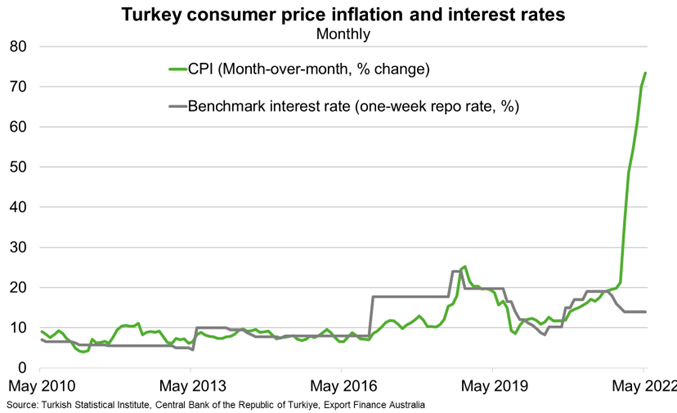
In Turkey, the president forced its central bank to maintain low rates even as inflation soared past 85 per cent. The decision served short-term political goals while devastating the purchasing power of everyday people.
Argentina's recurring economic crises have been exacerbated by monetary policy subordinated to political needs. Venezuela's hyperinflation accelerated after the government asserted greater control over its central bank.
The pattern tends to show that the more control the government has over monetary policy, the more the economy leans toward instability and higher inflation.
Independent central banks may not be perfect, but they have historically outperformed the alternative.
Turkey’s interest rates dropped in 2022 despite inflation skyrocketing
Why do markets care about Fed independence?
Markets generally prefer predictability, and independent central banks make more predictable decisions.
Fed officials often outline how they plan to adjust policy and what their preferred data points are.
Currently, the Consumer Price Index (CPI), Personal Consumption Expenditures (PCE) index, Bureau of Labor Statistics (BLS) monthly jobs reports, and quarterly GDP releases form expectations about the future path of interest rates.
This transparency and predictability help businesses map out investments, banks to set lending rates, and everyday people to plan major financial decisions.
When political influence infiltrates these decisions, it introduces uncertainty. Instead of following predictable patterns based on publicly released data, interest rates can shift based on electoral considerations or political preference, which makes long-term planning more difficult.
The markets react to this uncertainty through stock price volatility, potential bond yield rises, and fluctuating currency values.
The enduring logic
The independence of the Federal Reserve is about recognising that stable money and sustainable growth require institutions capable of making unpopular decisions when economic fundamentals demand them.
Elections will always create pressure for easier monetary conditions. Inflation will always tempt policymakers to delay painful adjustments. And the political calendar will never align perfectly with economic cycles.
Fed independence exists to navigate these eternal tensions, not perfectly, but better than political control has managed throughout history.
That's why this principle, forged in financial panics and refined through successive crises, remains central to how modern economies function. And it's why debates about central bank independence, whenever they arise, touch something fundamental about how democracies can maintain long-term prosperity.
Gold's breakthrough above US$5,000 and silver's surge through US$100 signal this year could be one for the history books for metal traders (one way or another).
Quick facts
Elevated safe-haven demand lifts Gold targets from US$5,400 to US$6,000 after early-year US$5,000 breakout.
Artificial intelligence (AI) and data-centre infrastructure ramp-up could help drive silver and copper demand.
Continued geopolitical uncertainty and shifting monetary policy could trigger metal volatility throughout the year.
Top 5 metals to watch in 2026
1. Gold
Gold's breakout over US$5,100 arrived three quarters ahead of some forecasts. With Bank of America quickly raising its end-of-year target to US$6,000 and Goldman Sachs projecting US$5,400, the safe-haven commodity remains the biggest asset in focus for 2026.
Key drivers:
Central banks are currently buying an average of 60 tonnes of gold per month, compared to 17 tonnes pre-2022.
Two Fed rate cuts are priced in for 2026, reducing the opportunity cost of holding non-yielding assets like gold.
Trump tariff policies, Middle East tensions, and fiscal sustainability concerns are keeping safe-haven demand elevated.
Gold's share of total financial assets hit 2.8% in Q3 2025, with room to grow as retail FOMO kicks in.
What to watch
Jerome Powell is set to be replaced as Fed chair in May 2026. Actual policy direction post-replacement may differ from current market expectations for cuts.
If geopolitical hedges into safe havens remain or if there is an unwinding like post- 2024 US election.
The potential weaponisation of dollar asset holdings by European nations as a response to US tariffs.
Silver is the metal that has benefited the most from the 2025 AI boom, with its surge to US$112 all-time-highs to kick off 2026 (70% above fundamental value as per Bank of America signal), demonstrating its volatile potential.
Key drivers
Industrial demand from AI infrastructure, solar, and electric vehicles (EVs), semiconductors and data centres currently has no viable substitute for silver's conductivity.
Six consecutive years of supply deficit, with above-ground stocks depleting and recycling bottlenecks limiting secondary supply.
Policy optics may matter. The US decision to add silver to its list of “critical minerals” has been cited as a potential factor in volatility, including around trade policy risk.
Retail participation can amplify price moves, particularly when the demand for gold becomes “too expensive”.
What to watch
If solar panel demand continues its trajectory, or if 2025 was the peak.
Whether the recycling supply responds to record prices by increasing silver refining and material processing capacity.
How exchange inventory and lease rates move as potential signals of physical tightness.
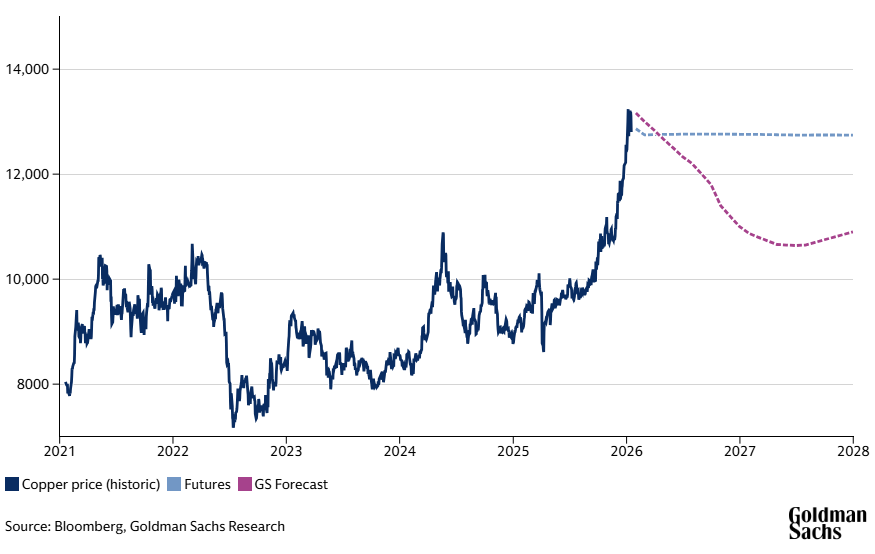
Copper's 2026 story hinges on continued data centre demand, renewable energy infrastructure growth, and China's struggling property market.
Key drivers
Data centre copper consumption is projected to hit 475,000 tonnes in 2026, up 110,000 tonnes from 2025.
Worker strikes in Chile and Grasberg restart delays are keeping the Copper market structurally tight.
The US tariff decision on refined copper imports is expected in mid-2026 (15%+ currently anticipated), creating potential stockpiling and trade flow distortions.
Goldman Sachs has forecast that power grid infrastructure and EV buildout could add "another United States" worth of copper demand by 2030.
Current Chinese property weakness is creating demand uncertainty, potentially offsetting infrastructure spending.
What to watch
Whether Grasberg ramps production smoothly or faces further setbacks.
Chinese property market stimulus effectiveness.
Actual tariff implementation timing and magnitude.
Yangshan premium movements signalling real physical demand versus financial positioning.
Goldman Sachs forecasts copper prices to drop to $11,000 per tonne by the end of 2026
4. Aluminium
Trading near three-year highs of US$3,200, aluminium faces continued tightness into 2026 as China's capacity ceiling forces global markets to adjust.
Key drivers
China's 45 million tonne capacity cap was reached in 2025. For the first time in decades, Chinese output cannot expand, potentially ending 80% of global supply growth.
As copper prices increase, Reuters has reported that some manufacturers have been substituting aluminium for copper in certain applications as relative prices shift.
What to watch
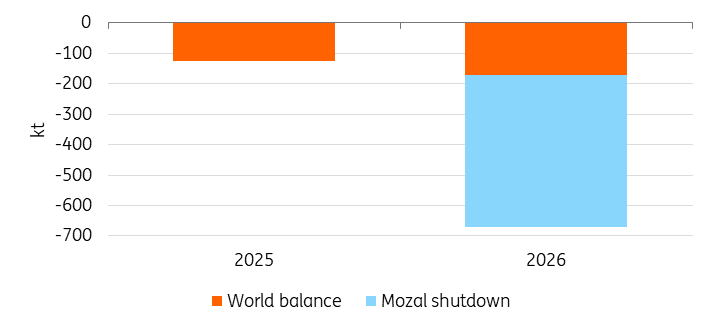
South32 has said Mozal Aluminium is expected to be placed on care and maintenance around 15 March 2026, thus removing Mozambique's 560,000 tonne significant supply.
If Indonesian and Chinese offshore capacity additions can compensate for Chinese domestic ceiling.
Century Aluminium's 50,000 tonne Mount Holly restart in Q2 could provide a signal for the broader industry as the smelter is expected to reach full production by 30 June 2026.
Projected 2026 Aluminium deficit after Mozal shutdown. Source: IAI, WBMS, ING Research
5. Platinum
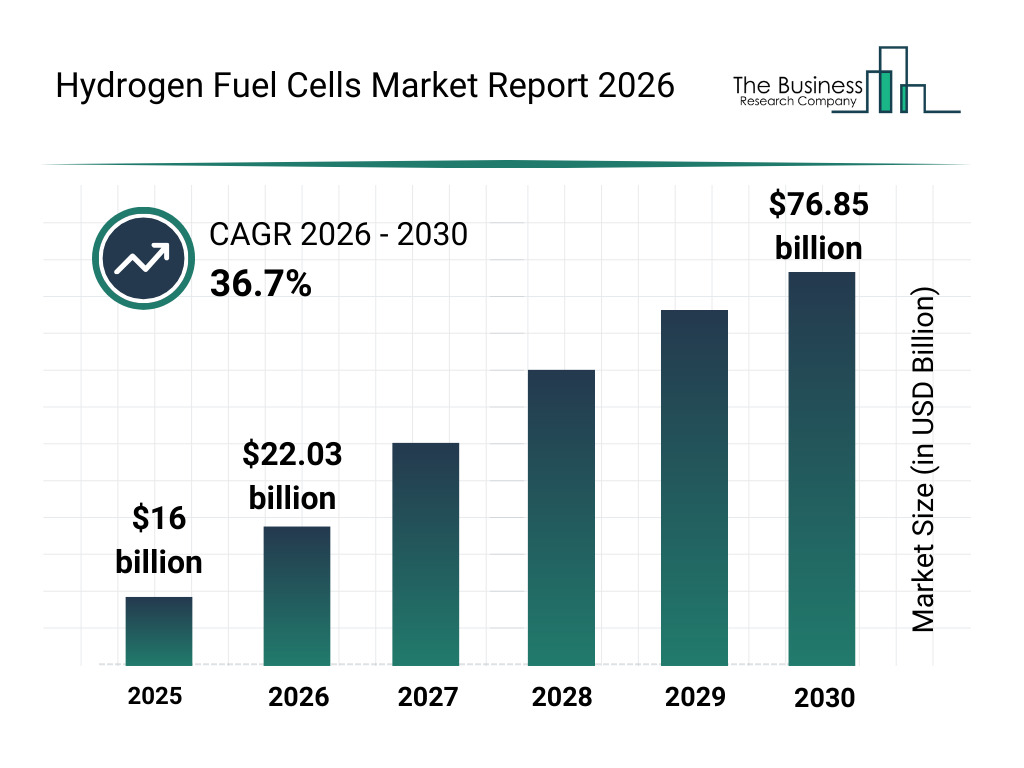
Platinum's breakout above US$2,800 follows three consecutive years of supply deficit and increased adoption of hydrogen fuel cells (for which it is a vital component).
Key drivers
The World Platinum Investment Council (WPIC) has forecast a significant supply deficit of 850,000 ounces in 2026 which could drain inventories, with limited new production coming online.
WPIC forecasts 875,000 to 900,000 oz uptake by 2030 for heavy-duty trucks, buses, and green hydrogen electrolysers.
Palladium-to-platinum substitution in catalytic converters is increasing in EV production.
What to watch
Supply response from producers. Platreef and Bakubung are adding 150,000 oz, but production discipline could limit a broader ramp-up.
US tariffs on Russian palladium could create spillover demand for platinum in EV production.
The pace of hydrogen infrastructure investment and heavy-duty vehicle adoption rates in Europe, China, and US.
Chinese jewellery demand could come into play. Just a 1% substitution from gold could widen the platinum deficit by 10% of the global supply.
Projected hydrogen fuel cell growth 2025-2030
You can trade Gold, Silver, and other Commodity CFDs, including energies and agricultural products, on GO Markets.
Venezuela commands the world's largest proven oil reserves at 303 billion (bn) barrels (bbl). Yet political turmoil, global sanctions, and recent US intervention show that being the biggest isn’t always best.
What does this mean for oil markets?
The concentration of reserves among Organization of the Petroleum Exporting Countries (OPEC) members (60% of the global total) gives the group ongoing influence on supply policy and market sentiment, even as US shale provides a production counterweight.
Venezuela's potential return as a major exporter post-US intervention could eventually ease supply constraints, though most analysts view significant production increases as years away.
Sanctions could create a situation where discounted crude seeks buyers willing to navigate compliance risks. Refiners with heavy crude processing capability may benefit from price differentials if Venezuelan barrels increase.
While reserves appear abundant, economically recoverable volumes depend on sustained high prices. If renewable adoption accelerates and demand peaks sooner than projected, stranded assets become a material risk for reserve-heavy producers.
Top 10 countries by proven oil reserves
1. Venezuela – 303 billion barrels
Controls 18% of global reserves, primarily extra-heavy crude in the Orinoco Belt requiring specialised refining.
Heavy crude typically trades $15-$20 below Brent benchmarks due to high sulphur content and complex processing requirements.
Output crashed by 60% from 2.5 million bpd in 2014 to less than 1 million barrels per day (BPD) last year.
Approximately 80% of exports flow to China as loan repayments, with export revenues dwarfed by reserve potential.
2. Saudi Arabia – 267 billion barrels
The majority of its light, sweet crude oil requires minimal refining and commands premium prices, contributing to world-leading exports of $191.1 bn in 2024.
Maintains 2-3 million bpd of spare production capacity, providing a stabilising buffer during supply disruptions.
Oil comprises roughly 50% of the country’s GDP and 70% of its export earnings.
Production decisions significantly impact international oil prices due to market dominance.
Heavy Western sanctions severely limit the country’s ability to monetise and access international markets.
Production estimates vary significantly (2.5-3.8 million bpd) due to sanctions, limited transparency, and restricted international reporting.
Significant crude volumes flow to China through discount arrangements and sanctions-evading mechanisms.
Sanctions relief could rapidly boost production toward 4-5 million bpd, though domestic consumption (12th globally) reduces export potential.
4. Canada – 163 billion barrels
Approximately 97% of reserves are oil sands (bitumen) requiring steam-assisted extraction and significant upfront capital investment.
Political stability and regulatory frameworks position Canada as a secure source compared to volatile producers, with direct pipeline access to US refineries.
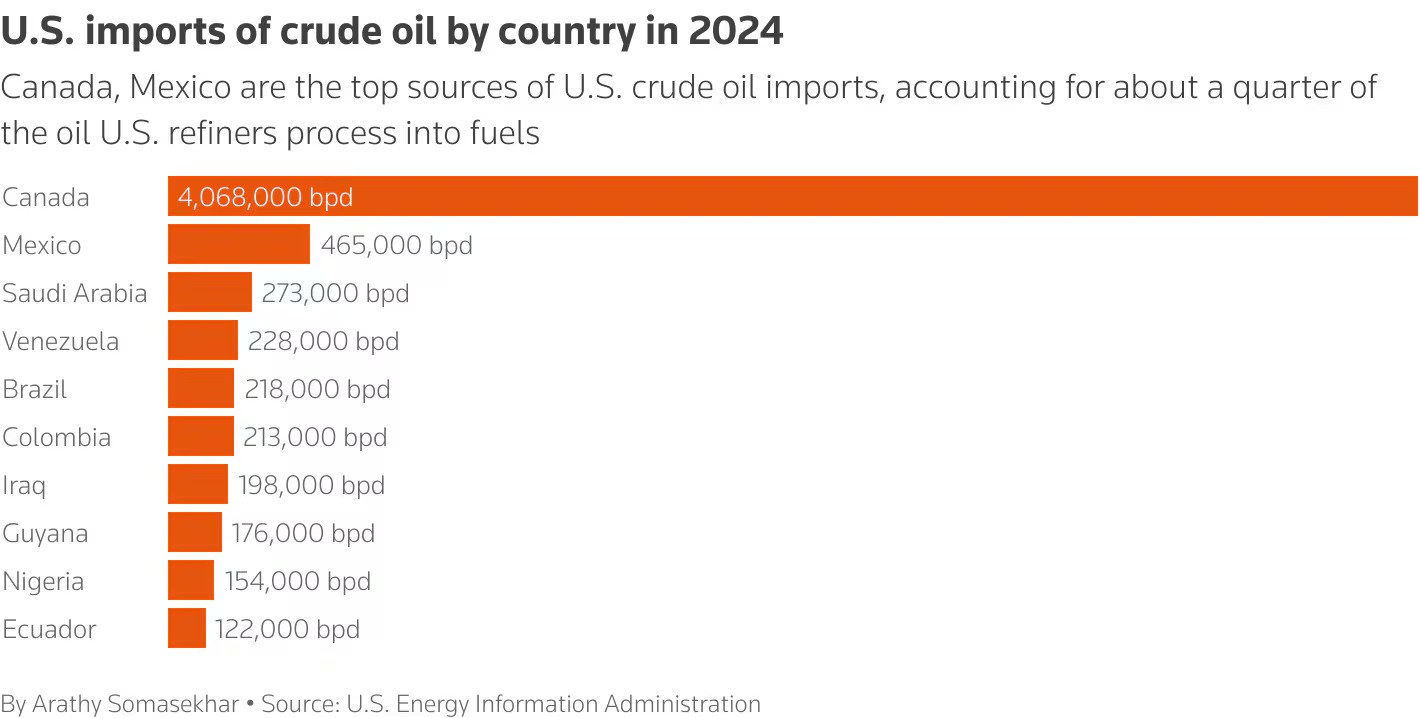
Supplied over 60% of US crude oil imports in 2024, making Canada America's top source by far.
5. Iraq – 145 billion barrels
Decades of war and sanctions have prevented optimal field development and infrastructure modernisation.
Improved security conditions since 2017 have enabled production recovery, but pipeline attacks and ageing facilities continue to constrain output.
Oil revenue comprises over 90% of government income, creating extreme fiscal vulnerability.
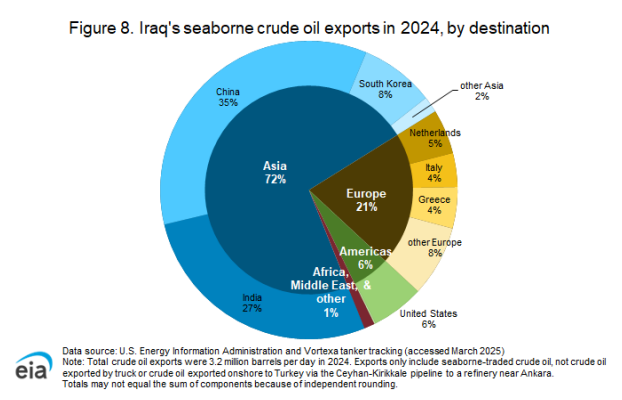
Exports flow primarily to China, India, and Asian buyers seeking a reliable Middle Eastern supply, with most production from super-giant southern fields near Basra.
6. United Arab Emirates – 113 billion barrels
Produces primarily medium-to-light sweet crude commanding premium prices, ranking fourth globally in export value at $87.6 bn.
Has successfully diversified its economy through tourism, finance, and trade, reducing oil's GDP share compared to Gulf peers.
Strategic location near the Strait of Hormuz and openness to international oil companies help facilitate efficient global distribution.
7. Kuwait – 101.5 billion barrels
Reserves are concentrated in ageingsuper-giant fields like Burgan, which require enhanced recovery techniques.
Favourable geology enables extraction costs around $8-$10 per barrel, with proven reserves providing 80+ years of supply at current production rates.
Oil comprises 60% of GDP and over 95% of export revenue.
8. Russia – 80 billion barrels
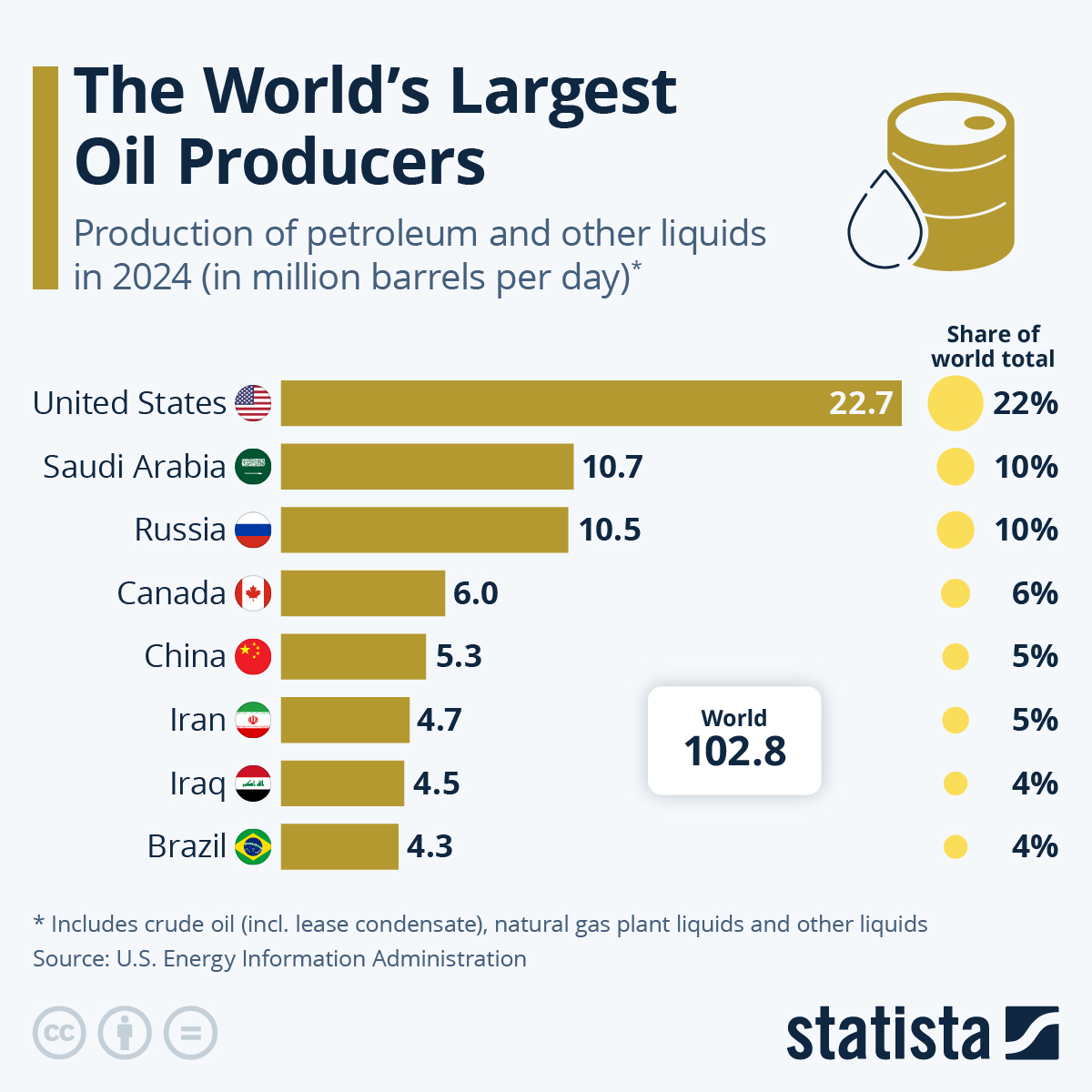
The world's third-largest producer despite ranking eighth in reserves.
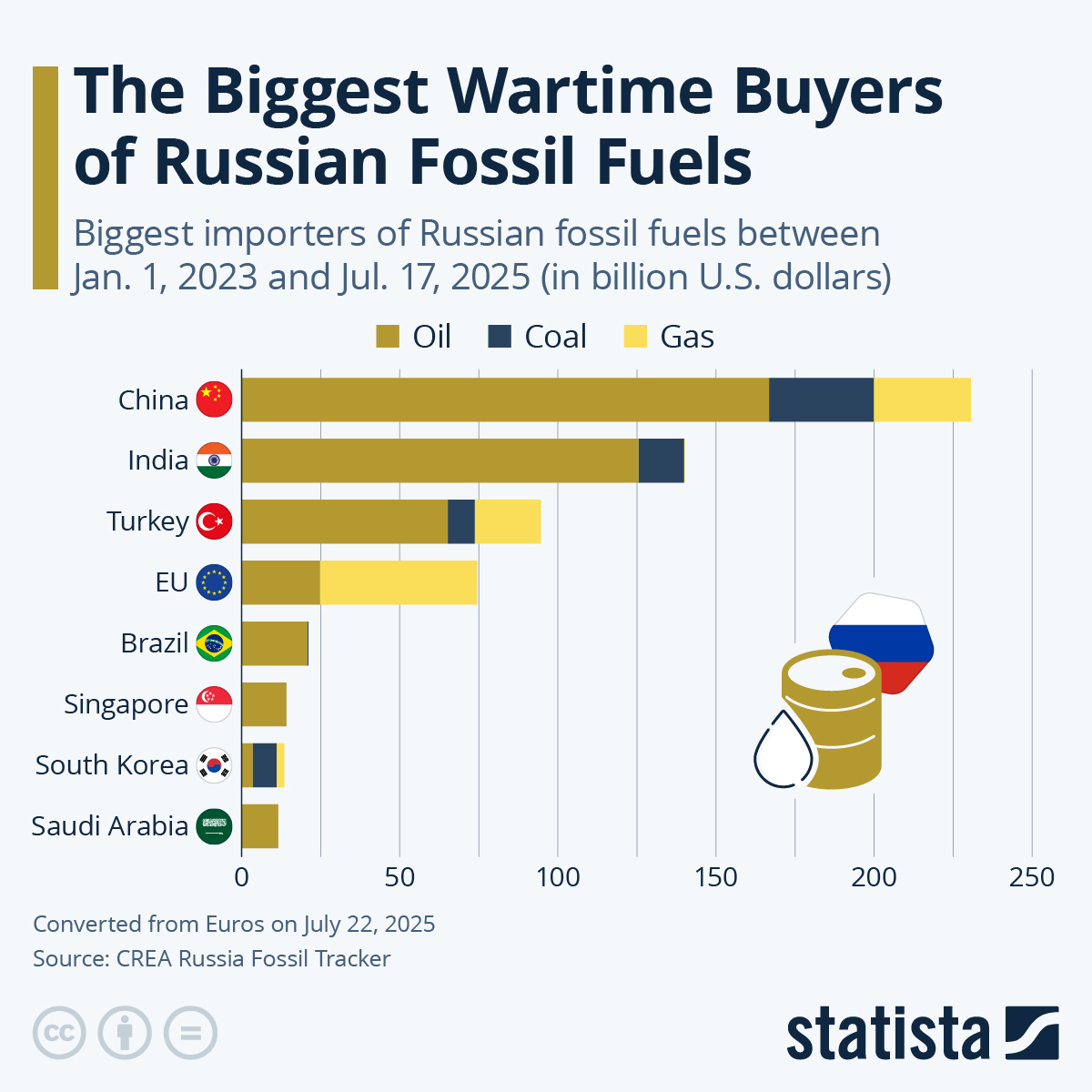
Post-2022, Western sanctions redirected crude flows from Europe to Asia, with China and India now absorbing the majority at discounted prices.
Despite export restrictions and G7 price cap at $60/barrel, it posted the second-highest global export value at $169.7 bn in 2024.
Russian Urals crude typically trades $15-30 below Brent due to quality, sanctions, and logistics, with November 2024 revenues declining to $11 bn.
9. United States – 74.4 billion barrels
The shale revolution through horizontal drilling and hydraulic fracturing has made the US the world's No.1 oil producer despite holding only the 9th-largest reserves.
The Permian Basin accounts for nearly 50% of production, with shale/tight oil representing 65% of total output.
Achieved net petroleum exporter status in 2020 for the first time since 1949, with crude exports growing from near-zero in 2015 to over 4 million bpd in 2024.
The US government maintains a strategic reserve of 375+ million barrels.
10. Libya – 48.4 billion barrels
Holds Africa's largest proven oil reserves at 48.4 bn barrels, producing light sweet crude commanding premium prices.
Rival bordering governments compete for oil revenue control, causing production to fluctuate based on political conditions.
Oil facilities face blockades, militia attacks, and political leverage tactics, preventing consistent returns.
Favourable geology enables extraction costs around $10-15 per barrel, with geographic proximity making Libya a natural supplier to European refineries.
You can trade Oil and other Commodity CFDs, including metals, energies, and agricultural products, on GO Markets.
The 8 April ceasefire announcement and parallel discussions around a 45-day truce have not resolved the Strait of Hormuz disruption. They have, for now, capped the worst-case scenario, but tanker traffic remains at a fraction of normal levels and Iran's demand for transit fees signals a structural shift, not a temporary one.
What began as a regional conflict has become a global energy shock, and the question for markets is no longer whether Hormuz was disrupted, but how permanently the disruption changes the pricing floor for oil.
Key takeaways
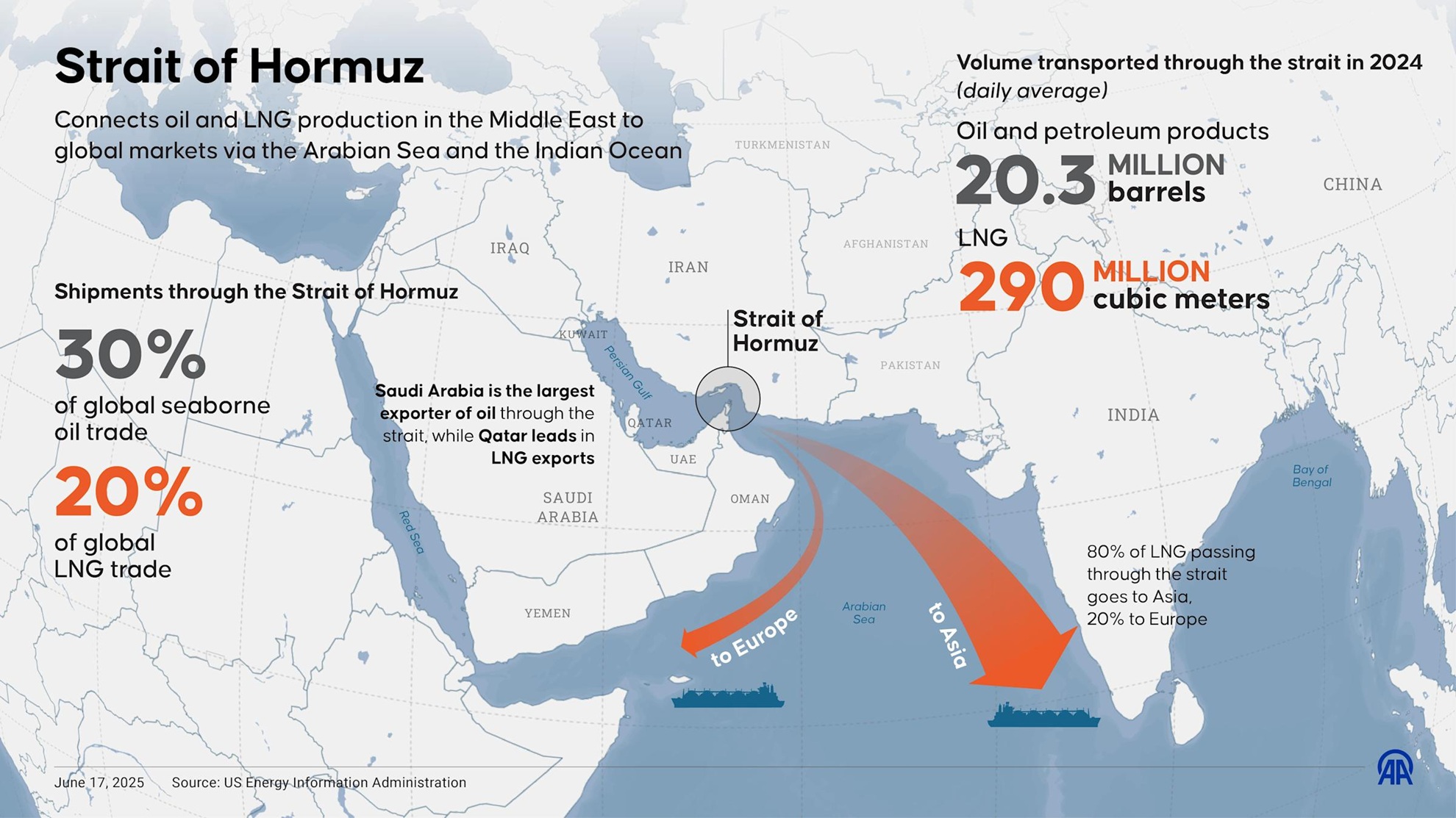
Around 20 million barrels per day (bpd) of oil and petroleum products normally pass through the Strait of Hormuz between Iran and Oman, equal to about one-fifth of global oil consumption and roughly 30% of global seaborne oil trade.
This is a flow shock, not an inventory problem. Oil markets depend on continuous throughput, not static storage.
If the disruption persists beyond a few weeks, Brent could shift from a short-term spike to a broader price shock, with stagflation risk.
Tanker traffic through the strait fell from around 135 ships per day to fewer than 15 at the peak of disruption, a reduction of approximately 85%, with more than 150 vessels anchored, diverted, or delayed.
A two-week ceasefire was announced on 8 April, with 45-day truce negotiations under way. Iran has separately signalled a demand for transit fees on vessels using the strait, which, if formalised, would represent a permanent geopolitical floor on energy costs.
Markets have begun rotating away from growth and technology exposure toward energy and defence names, reflecting a view that elevated oil is becoming a structural cost rather than a temporary risk premium.
Institutional Grade Performance
Master the Markets with MetaTrader 5
Trade hundreds of instruments with superior speed and advanced technical analysis. Harness full EA functionality to execute your strategy.
The Strait of Hormuz handles roughly 20 million barrels per day of oil and petroleum products, equal to about 20% of global oil consumption and around 30% of global seaborne oil trade. With global oil demand near 104 million bpd and spare capacity limited, the market was already tightly balanced before the latest escalation.
The strait is also a critical corridor for liquefied natural gas. Around 290 million cubic metres of LNG transited the route each day on average in 2024, representing roughly 20% of global LNG trade, with Asian markets the main destination.
The International Energy Agency (IEA) has described Hormuz as the world’s most important oil transit chokepoint, noting that even partial interruptions may trigger outsized price moves. Brent crude has moved above US$100 a barrel, reflecting both physical tightness and a rising geopolitical risk premium.
Source: US Energy Information Administration, dated June 17, 2025, using 2024 daily average
Tankers idle as flows slow
Shipping and insurance data now point to strain in real time. More than 85 large crude carriers are reported to be stranded in the Persian Gulf, while more than 150 vessels have been anchored, diverted or delayed as operators reassess safety and insurance cover. That would leave an estimated 120 million to 150 million barrels of crude sitting idle at sea.
Those volumes represent only six to seven days of normal Hormuz throughput, or a little more than one day of global oil consumption.
Updated shipping and insurance data now confirm more than 150 vessels have been anchored, diverted, or delayed, up from the 85 initially reported. The 1.3 days of global consumption coverage from idle crude remains the binding constraint: this is a flow shock, not a storage problem, and the ceasefire has not yet translated into meaningfully restored throughput.
🌋 Trump, volatility and Hormuz.
As tariff shocks collide with a ten year extreme in oil positioning, the margin for error is zero. See the technical markers and safe haven pivots defining the current risk environment.
Oil markets function on continuous movement. Refineries, petrochemical plants and global supply chains are calibrated to steady deliveries along predictable sea lanes. When flows through a chokepoint that carries roughly one-fifth of global oil consumption and around 30% of global seaborne oil trade are interrupted, the system can move from equilibrium to deficit within days.
Spare production capacity, largely concentrated within OPEC, is estimated at only 3 million to 5 million bpd. That falls well short of the volumes at risk if Hormuz flows are severely disrupted.
GO Markets — Idle Tankers: Days of Cover
Oil market analysis
How long do idle tankers last?
135M idle barrels — days of cover against each demand benchmark
vs. Strait of Hormuz daily flow (20M bbl/day)
6.75 daysof Hormuz throughput covered
6.75 days
0
5
10
15
20
25
30 days
vs. Global oil consumption (104M bbl/day)
1.3 daysof world demand covered
1.3 days
0
5
10
15
20
25
30 days
vs. US Strategic Petroleum Reserve release (1M bbl/day)
135 daysof full SPR release pace covered
135 days — but SPR exists to replace this role
0
5
10
15
20
25
30 days
135M
idle barrels on tankers (midpoint of 120–150M range)
~33%
of daily Hormuz flow that is idle storage, not transit
<31 hrs
is all idle storage against global daily consumption
Indicative market trajectories based on disruption severity
Scenarios for the weeks ahead
1–2 WEEKS
Ceasefire catch-up
Markets face catch-up repricing. Brent could consolidate in the US$105–US$115 range as risk premia unwind. Brent may trade lower (US$95–US$110) if strategic stocks bridge the temporary shortfall.
2–4 WEEKS
Infrastructure blitz
Shifts to structural supply shock. Brent moving toward US$150–US$200 cannot be ruled out. This is the stagflation trigger where energy costs constrain central bank flexibility.
STRUCTURAL
Geopolitical floor
Iran's transit fee demand creates a permanent input cost. The pre-crisis price structure (US$60–US$70) may not return, embedded in insurance and freight rates.
Critical Threshold
US$120 remains the level at which energy inflation becomes a direct Federal Reserve policy problem.
Inflation risks and macro spillovers
The inflationary impact of an oil shock typically arrives in waves. Higher fuel and energy prices may lift headline inflation quickly as petrol, diesel and power costs move higher.
Over time, higher energy costs may pass through freight, food, manufacturing and services. If the disruption persists, the combination of elevated inflation and slower growth could raise the risk of a stagflationary environment and leave central banks facing a difficult trade-off.
🛢️ Brent hits $100.
Exxon and SLB are leading the rotation out of tech. Get the price targets and technical support levels for the top 5 energy majors.
What makes the current episode particularly acute is the lack of slack in the global system.
Global supply and demand near 103 million to 104 million bpd leave little spare cushion when a chokepoint handling nearly 20 million bpd, or about one-fifth of global oil consumption, is compromised. Estimated spare capacity of 3 million to 5 million bpd, mostly within OPEC, would cover only a fraction of the volumes at risk.
Alternative routes, including pipelines that bypass Hormuz and rerouted shipping, can only partly offset lost flows, and usually at higher cost and with longer lead times.
Bottom line
Until transit through the Strait of Hormuz is restored and seen as credibly secure, global oil flows are likely to remain impaired and risk premia elevated. For investors, policymakers and corporate decision-makers, the core question is whether oil can move where it needs to go, every day, without interruption.
Market Opportunity
Don't just watch the squeeze. Trade the framework.
As positioning gaps hit decade extremes, access advanced charting tools and real time execution on the six key markets defining this cycle.